

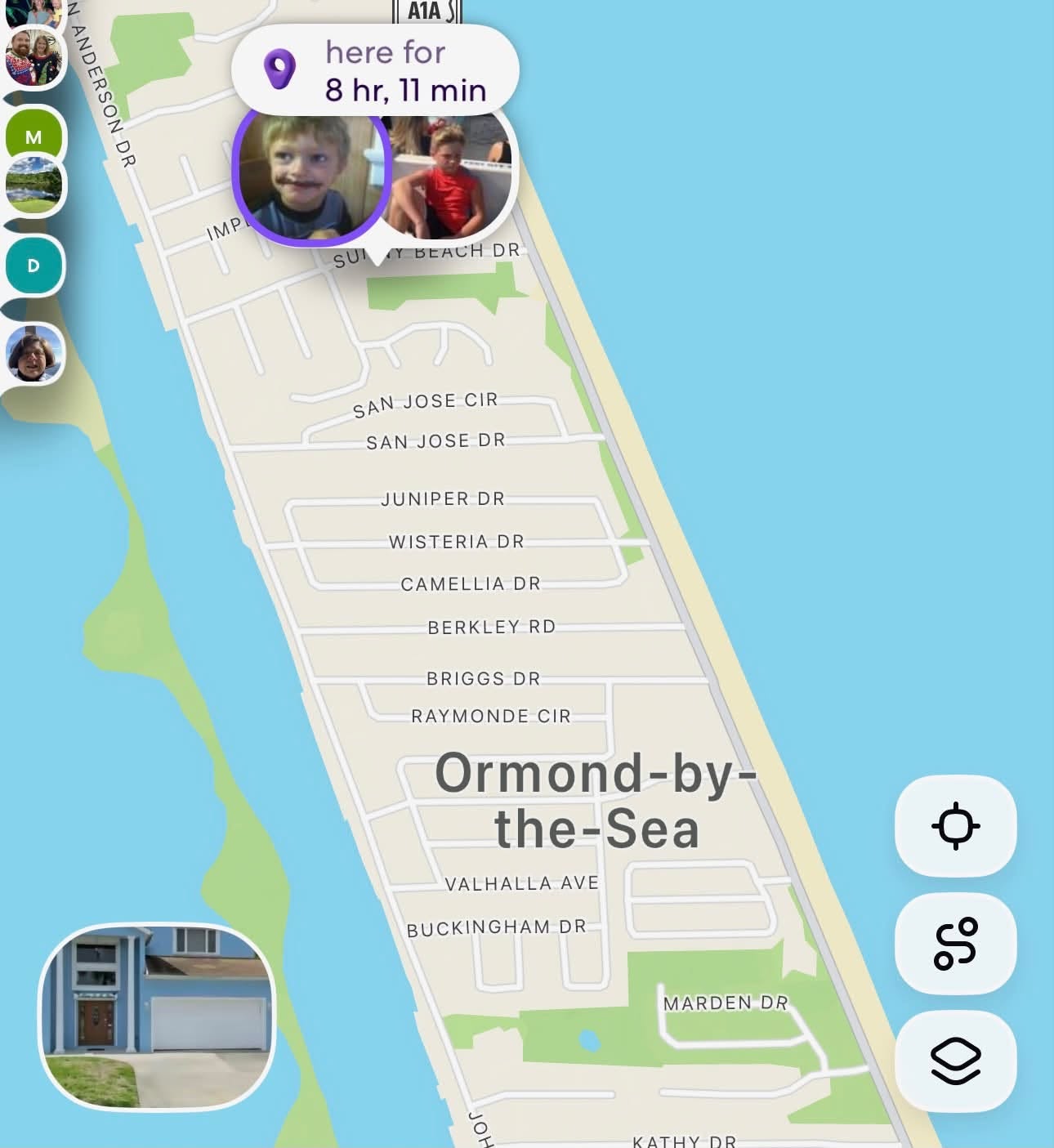
My two older sons took off with a group of friends to a buddy’s uncle’s beach house in Ormond Beach, Florida on Sunday afternoon. I’ve checked Life360 a few times to see where they are. I’ve gotten one two minute phone call as one of them was leaving Sam’s Club and one text from the other.
So, you know, basically full and constant communication.
I sure hope they’re doing okay, but I also have to remember that they are under God’s care and provision in Ormond Beach, Florida, just as much as they are in Coronaca, South Carolina.
Fear is an almost universal emotion. What we fear and how fear affects us is unique to each person. I seldom fear physical harm from bad people or health concerns, but I am sensitive to financial disruptions in our home’s budget. So I’m certainly not immune to fear at all.
Fear is one of the prime drivers of anxiety and worry that can be so crippling to so many people. And to be fair, fear and anxiety can be complicated. Sometimes we learn fear from our parents. Sometimes we learn it from difficult experiences. Sometimes it grows from the overwhelming onslaught of bad news we see every day.
But as Christians, we also have to acknowledge this: fear that refuses to trust God is not harmless. It is a kind of insult to the God we claim is both sovereign and good.
Jesus repeatedly connects fear and worry to a lack of trust:
“Why do you have so little faith?”
Matthew 6:30
“Why are you afraid? You have so little faith!”
Matthew 8:26
“Don’t worry about anything; instead, pray…”
Philippians 4:6
“Give all your worries and cares to God…”
1 Peter 5:7
The Bible is not saying we never feel fear. David himself says elsewhere, “When I am afraid, I will put my trust in you” (Psalm 56:3). The issue is not whether fear ever knocks on the door. The issue is whether we invite it in, feed it, and let it run the house. This is the essence of uncontrolled and raging anxiety.
This morning I came to Psalm 27, where David writes:
“The Lord is my light and my salvation—so why should I be afraid?” Psalm 27:1
David is not writing as a man facing imaginary problems. He is writing as a warrior with real enemies and real danger. He talks about evil people coming against him, enemies attacking him, and even armies surrounding him.
Yet his reasoning is simple and strong.
The Lord is my light.
Fear grows in the dark. It thrives in uncertainty, imagination, and worst-case scenarios. But the Lord gives light. He shows us what is true. He reminds us who He is. He gives enough light for the next step, even when He does not show us the whole road.
The Lord is my salvation.
David’s life is not ultimately in the hands of his enemies. My sons’ lives are not ultimately in the hands of traffic, weather, strangers, or their own youthful decision-making. My life is not ultimately in the hands of the economy, a bank account, or a doctor’s report.
God is the one who saves. He may deliver us from trouble, or He may sustain us through trouble, but His people are never outside His saving care.
Then David says:
“The Lord is my fortress, protecting me from danger, so why should I tremble?”
Psalm 27:1
A fortress does not mean there are no enemies outside. It means there is protection around you.
If the Lord is our fortress, then nothing reaches us by accident. Anything that comes inside the walls has first passed through the wise and loving permission of God. That does not mean every hard thing is good in itself. But it does mean every hard thing is governed by a good God.
That is why David can say:
“Though a mighty army surrounds me, my heart will not be afraid.”
Psalm 27:3
David’s confidence in Psalm 27 does not mean that there are no enemies, that nothing bad can happen or that life is always safe.
But that the Lord is his light, his salvation, and his fortress.
And of course, we see this most clearly in Jesus.
Luke tells us that Jesus “set his face” toward Jerusalem. He moved toward betrayal, suffering, and the cross with steady courage. He was not fearless because the road was painless. He was fearless because He trusted His Father’s good plan.
At the cross, it looked like darkness had won. But on Easter morning, the light broke through. Salvation was accomplished. The fortress held.
So today, whether our children are in Ormond Beach, our finances feel uncertain, our health is fragile, or our minds are crowded with what-ifs, Psalm 27 gives us a better question:
If the Lord is my light, my salvation, and my fortress, whom shall I fear?
Not because life is safe.
But because God is good.
Not because we are in control.
But because we belong to Him.